
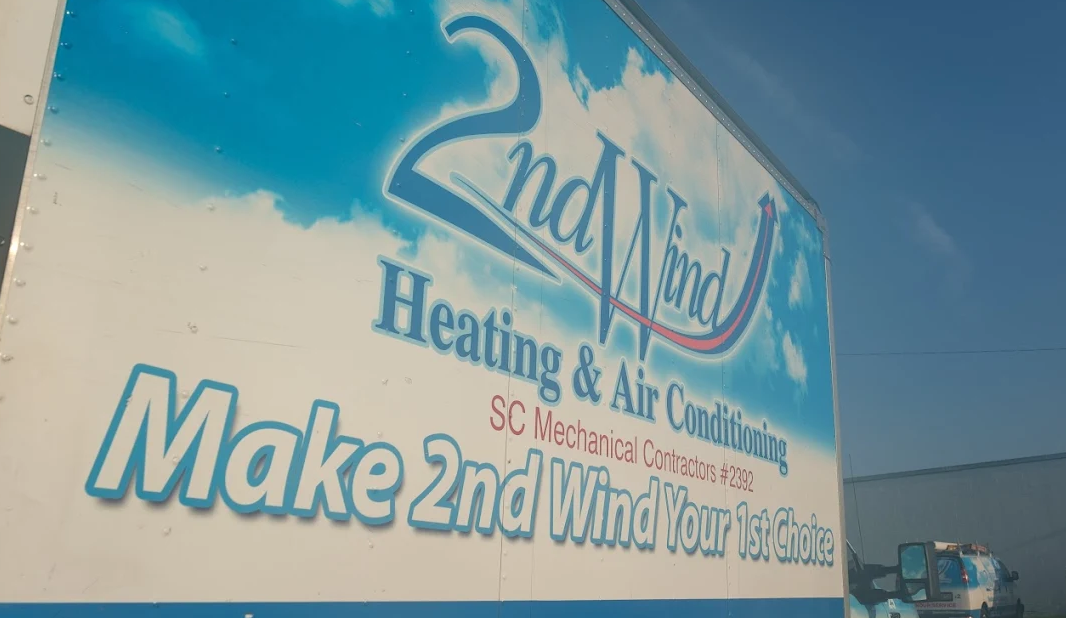
Every 2nd Wind Heating & Air Conditioning truck carries a license number. Most homeowners never give it a second look, and that is understandable, since a license number is not the first thing anyone thinks about when the air conditioner quits in July. It deserves a look, though, because that number is what stands behind the work when something goes wrong. It is what separates a contractor from someone with a truck and a set of tools. This post explains what the license is, what South Carolina requires to hold it, what it protects, and how to check any contractor’s license before you hire, ours included.
The license itself
In South Carolina, heating, air conditioning, and plumbing work on homes is licensed by the Contractor’s Licensing Board under the Department of Labor, Licensing and Regulation, and a mechanical contractor’s license is what the state requires of any company that performs that work above a modest dollar threshold. The license is issued to the company, it carries the classifications for the trades the company is qualified to perform, and it is renewed on a schedule with the state. It is a public record that holds those in the trade accountable.
South Carolina’s requirements
A mechanical contractor’s license is not just a fee and a form. The state requires the company’s qualifying party to pass trade and business examinations, requires evidence of financial responsibility, and requires that the license be kept current, and it can suspend or revoke a license for work that violates the code or for complaints it upholds. The technicians doing refrigerant work must also hold federal EPA Section 608 certification, which the license framework depends on. Each of those requirements exists because heating, cooling, and plumbing work involves refrigerant under pressure, gas lines, combustion equipment, and water inside walls, and the state decided long ago that the person doing that work should have proved they know how.
The protection it provides when something goes wrong
Permits and inspections come first, because licensed work on a new system, a gas line, or a water heater is permitted and inspected by the local authority, which is a second set of eyes on work that can hurt a house or a household if it is done wrong, and unpermitted work is a problem at resale and sometimes at insurance time. Warranties come next, since most equipment manufacturers require installation by a licensed contractor to honor the parts warranty, and a compressor claim denied for an unlicensed install is an expensive way to learn that. Insurance is the third, because a licensed contractor carries liability and workers’ compensation coverage, so an injury on your property or damage to your home is the contractor’s insurer’s problem rather than yours. And recourse is the last, because a complaint against a licensed contractor goes to the state board, which has the power to act on it, while a complaint against an unlicensed individual goes nowhere.
Why the lower quote can cost more
The brief version is this: an unlicensed individual can quote less because they are not carrying what the license requires, and what they are not carrying is exactly what you are relying on if the work fails. No permit means no inspection, no license means the manufacturer’s warranty may not apply, no insurance means an accident on your property is yours, and no board means no recourse. A refrigerant charge set by feel, a gas line without a pressure test, or a water heater without a proper relief valve can look fine for a season and fail in a way that costs many times the difference in the quotes.
How to check any contractor’s license
- Ask for the license number before the work is scheduled. A licensed contractor expects the question and has the number on the truck, the paperwork, and the website.
- Look it up on the South Carolina LLR license lookup, which shows whether the license is active, what classifications it carries, and whether the board has taken action against it.
- Confirm the company carries liability and workers’ compensation insurance, and ask for the certificate if the job is large.
- Ask whether the job will be permitted, since a licensed contractor pulls permits for the work that requires them and does not treat the question as an inconvenience.
- Ask for the technician’s EPA 608 certification on any job involving refrigerant.
The license at 2nd Wind
2nd Wind has held its South Carolina mechanical contractor’s license through four decades of work in Columbia and the Midlands. Our technicians document each visit and review the readings and the recommendation with you, so the work and the reasoning are transparent, and every repair and installation is permitted where the code requires it. Members of the Cloud 10 Membership receive a one-year parts and labor warranty on repairs, which is a promise a licensed company can make because the state stands behind its license.
Hiring with the number in hand
If you are comparing contractors for a repair, a replacement, or a plumbing job in Columbia, start with the license number and the lookup, and then compare the quotes. 2nd Wind Heating & Air Conditioning has served Columbia since 1985; schedule online or through the website chat at any hour, and same-day emergency service available for residential jobs.