
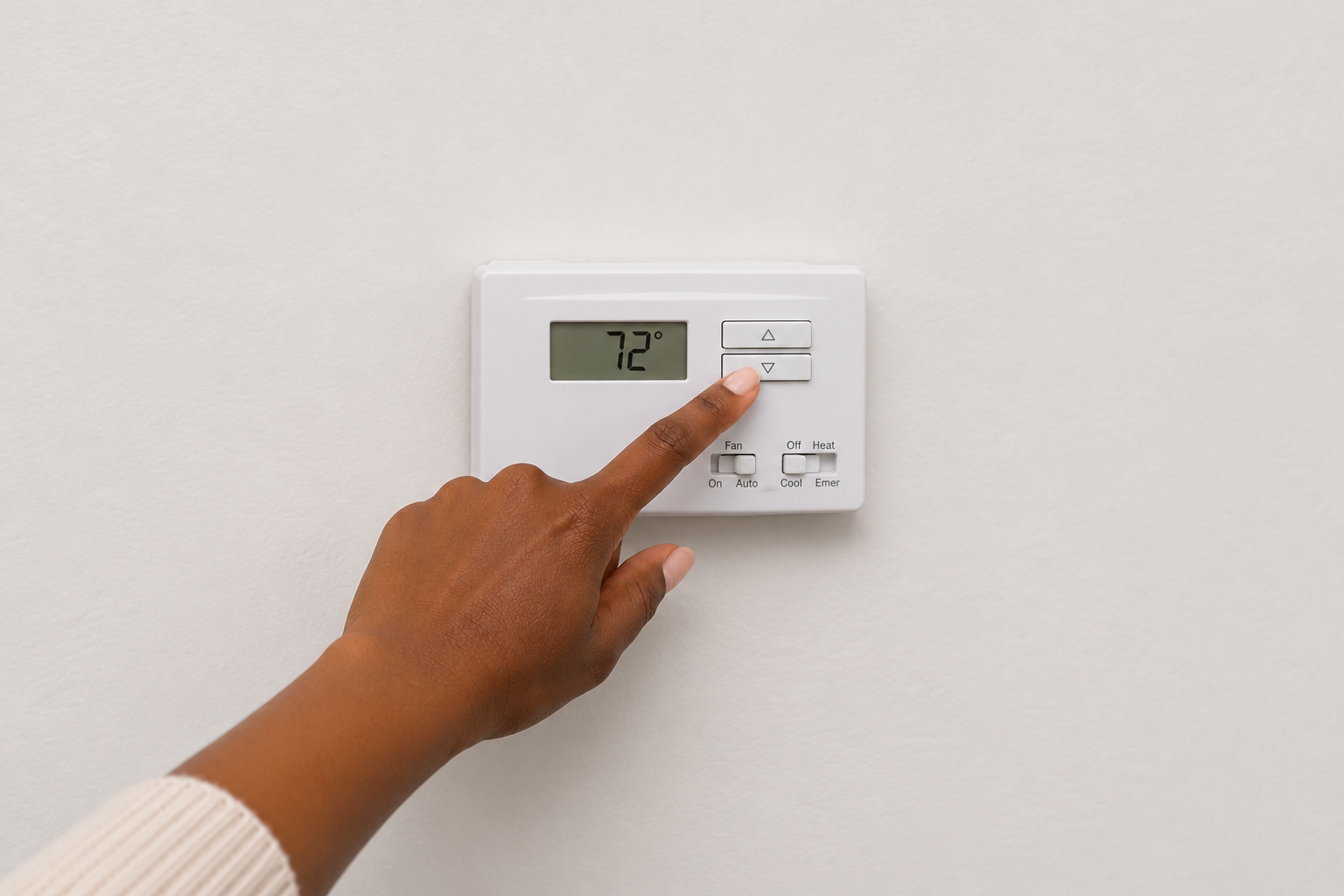
Three simple tests tell you whether your thermostat is working properly: a thermometer test that checks whether it reads the room accurately, a response test that checks whether the system reacts when you change the setting, and a hold test that checks whether it keeps the settings and schedule you give it. A thermostat that passes all three is doing its job, and the problem is in the equipment. A thermostat that fails one of them has a specific, usually inexpensive fix.
The thermostat is the smallest part of the system and the one most often blamed, so ten minutes of testing before anyone opens the air handler saves a service call in one direction or the other.
Test One: The Thermometer Test
Set a reliable thermometer next to the thermostat for 15 minutes and compare the readings. They should match within a degree or two. A larger gap means the thermostat’s sensor has drifted or the thermostat is mounted somewhere that misleads it: in direct sunlight, next to a supply register, on an exterior wall, near a lamp or a television, or in a hallway that runs warmer or cooler than the rest of the house. Then carry the thermometer to the room that feels wrong and compare again. A thermostat that reads its own wall correctly while the far bedroom runs five degrees warmer is not the problem. The ductwork or the balance of the system is.
Test Two: The Response Test
Set the thermostat five degrees below the room temperature in cooling mode, or five above it in heating, and listen. Within a minute or two you should hear a click at the thermostat, the indoor blower starting, and the outdoor unit starting. On a gas furnace, you should hear the inducer fan, then the igniter, then the burners. If nothing responds at all, check the batteries, the breakers, and the power switch at the indoor unit, then run the test again. If the blower runs but the outdoor unit never starts, the thermostat is sending the call and the problem is at the equipment. If the display changes but nothing happens anywhere, the thermostat may have lost its connection to the control board.
Test Three: The Hold Test
Program a simple schedule, or set a temperature and leave it, then check the next morning. A thermostat that drifted off the setting, lost its program, reset its clock, or shows a blank screen after a power blink is failing to hold, and the usual causes are dead batteries, a loose connection, or a unit whose memory has reached the end of its life. A programmable thermostat that loses its schedule every time the power flickers is telling you it is time for a replacement rather than another round of reprogramming.
What the Results Mean
- Fails the thermometer test: relocate the thermostat, add a remote sensor, or replace a unit whose sensor has drifted.
- Fails the response test with no activity anywhere: wiring, batteries, a blown low-voltage fuse, or a failed thermostat.
- Fails the response test with the blower running but the outdoor unit silent: the equipment, not the thermostat.
- Fails the hold test: batteries first, then replacement.
- Passes all three: the problem is in the system, and a technician’s visit should start at the equipment.
Three Patterns That Look Like Thermostat Problems and Are Not
A system that short-cycles, starting and stopping every few minutes, can come from a thermostat placed in a sunny spot, but it more often comes from a clogged filter, a frozen coil, or a furnace shutting down on its high-limit switch. A system that will not shut off can come from a stuck thermostat relay, but it can also mean the equipment cannot reach the setpoint because of a refrigerant leak or leaky ducts. And a heat pump showing Aux Heat on a mild Columbia day is usually a thermostat setup problem rather than a thermostat failure, since the backup strips should only come on when the heat pump cannot keep up.
When a Replacement Makes Sense
A thermostat that fails the hold test or the thermometer test is usually replaced rather than repaired, because a new unit costs less than diagnosing an old one. If you are replacing it anyway, a smart thermostat adds a schedule that runs itself, remote control from your phone, filter reminders, and alerts when runtime climbs. The setup matters most on a heat pump, which is the most common system in the Midlands: a thermostat configured correctly limits the backup heat strips to the few nights that need them, and one configured wrong runs them all winter.
Getting a Clear Answer
2nd Wind has served Columbia since 1985, and our trained experts test the thermostat, the control wiring, and the equipment it talks to, then record video of what they find so you can see where the fault sits. When more than one fix is reasonable, you hear the options explained. Schedule a visit online or reach our team through 24/7 website chat, and same-day service for residential customers is arranged by phone when the system will not respond at all.
Frequently Asked Questions
How accurate should a thermostat be?
Most digital thermostats read within a degree of the air at the sensor, and many allow a calibration offset in the settings menu if the reading drifts. A gap of three degrees or more that an offset cannot fix means the sensor is failing. Mechanical thermostats drift more and are replaced rather than calibrated.
Why does my thermostat click but nothing turns on?
The click is the thermostat’s relay closing to send the call, so the thermostat has done its part. Power is not reaching the equipment, the low-voltage fuse on the furnace control board has blown, a safety switch such as a float switch or a door switch is open, or the equipment has a failed component. That is a technician’s call, and it is usually a quick one.
Can I move my thermostat myself?
Moving a thermostat means running new low-voltage wire through the wall to the new location, patching the old spot, and reconnecting the wires correctly at both ends. It is low voltage, so the risk is to the equipment rather than to you, but a miswired thermostat can damage a control board. Most homeowners have a technician do it during a service visit.
Does a thermostat need to be replaced when the system is replaced?
Usually yes, because new two-stage and variable-speed equipment needs a thermostat that can control its stages, and a heat pump needs one that manages backup heat correctly. The thermostat that came with a 2010 system rarely matches a 2026 system’s capabilities. A new installation includes a compatible thermostat.
What does the Hold button on my thermostat do?
Hold overrides the programmed schedule and keeps the current setting until you cancel it or, on some models, until the next scheduled change. A thermostat left on permanent Hold loses every bit of the savings a schedule provides, which is the most common reason a programmable thermostat saves nothing. Check for a Hold indicator if the system seems to ignore its schedule.