
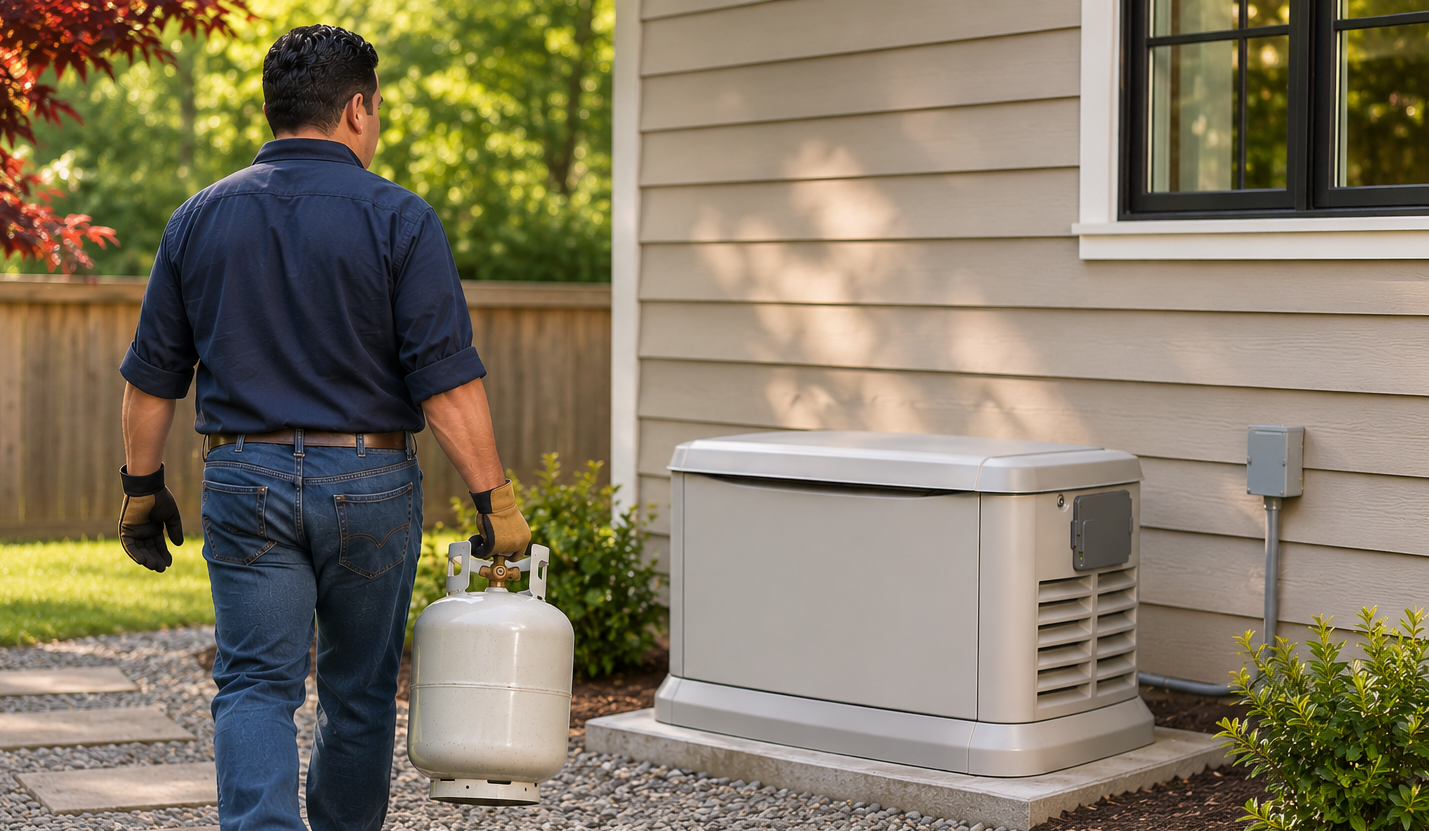
Four questions decide which fuel a home generator should burn: whether natural gas is connected to the house, how long outages tend to last where you live, where a fuel tank could go on the property, and what you need the generator to run. Answer those and the fuel chooses itself. Natural gas fits a home with gas service, because the supply never runs out. Propane fits a home beyond the gas mains, with a tank that keeps the fuel under your control. Diesel fits a large property with heavy, long-duration needs and the room and the appetite for a tank and its maintenance, which describes very few Midlands homes.
Here are the four questions and how each fuel answers them.
Question One: Is Natural Gas Connected to the House?
Natural gas service reaches most of Columbia, Cayce, West Columbia, Irmo, and Lexington, and a home that already heats water or cooks with gas has the fuel at the meter. A natural gas generator connects to that line, draws fuel for as long as the utility’s system stays pressurized, and never needs a tank, a delivery, or a check of the fuel level. Gas service stayed on across the Midlands during the Helene outages of 2024 even where electricity was out for a week. The limits are practical: the meter and the line to the generator must be sized for its demand, which sometimes means a meter upgrade, and natural gas carries slightly less energy per unit than propane, so the same engine produces a little less output.
Homes beyond the mains, which includes large parts of rural Kershaw, Newberry, and Fairfield counties and many properties around Lake Murray, answer this question with propane.
Question Two: How Long Do Outages Last Here?
A summer thunderstorm takes power down for a few hours. An ice storm like February 2014 or a tropical remnant like Helene takes it down for days. The longer the outage, the more the fuel supply matters. Natural gas handles any length of outage without attention. Propane handles it as long as the tank holds, which is why installers size a residential tank for several days of typical use and why topping it off before storm season is part of ownership. Gasoline-fed portables fail this question first, because the stations that sell gasoline lose power too, as Columbia learned after Helene.
Question Three: Where Can a Tank Go?
Natural gas needs no tank. Propane needs a tank sized for the generator and placed to meet fire code setbacks from the house, the property line, and any ignition source, either above ground or buried. A quarter-acre lot in a Lexington subdivision can usually fit one, and a lake lot with a steep slope or a septic field sometimes cannot without creative placement. Diesel needs a tank too, with containment and setback requirements that are harder to meet on a residential lot, and diesel fuel degrades in storage without stabilizer and can grow algae in a tank that collects condensation. Those tank requirements are the main reason diesel stays in commercial buildings.
Question Four: What Do You Need to Run?
The load decides the generator’s size, and the size decides how much fuel it uses per hour. A generator sized to run the whole house, including central air conditioning, uses far more fuel than one sized for the refrigerator, lights, the well pump, and the furnace blower. Natural gas and propane both scale from small to whole-house units. Diesel’s strengths, long engine life and efficiency under heavy sustained load, matter most for the largest installations, such as a farm, a property with medical equipment, or a home that doubles as a business.
How the Fuels Compare in Practice
- Natural gas: unlimited supply during an outage, no tank, simple maintenance, slightly lower output per engine size, requires gas service and a properly sized meter.
- Propane: independent supply under your control, stores indefinitely, slightly higher output than natural gas, requires a tank with setbacks and a delivery schedule.
- Diesel: efficient under heavy load, long engine life, requires a tank with containment, fuel that needs stabilizing, more noise and maintenance, rarely practical for a residence.
- Dual-fuel models: many residential standby generators run on either natural gas or propane, so a propane home that later gets gas service converts without a new generator.
Choosing for Your Property
For most Midlands homes the answer is settled by the first question. Gas at the meter means a natural gas generator. No gas means propane, with a tank sized for the outages this region sees. Diesel is the answer to a question most homeowners are not asking. Whatever the fuel, the generator is sized from a load calculation of what you want to run, not from the largest unit that fits the budget.
Getting a Recommendation for Your Home
2nd Wind has served Columbia and the surrounding Midlands since 1985, and our trained experts look at what your home already has, what your property can support, and what your household needs from backup power before recommending a whole-home generator. The fuel connection, the electrical work, the transfer switch, and the permit are handled as one job, and financing options are available. Schedule a generator consultation online or reach our team through 24/7 website chat, and we will help you choose the fuel and the system that fit.
Frequently Asked Questions
Does a natural gas generator need its own gas meter?
Usually not a separate meter, but the existing meter and the line to the generator must be sized for the generator’s demand on top of the furnace and water heater. The gas utility often upgrades the meter at little or no cost when a generator is installed. Your installer confirms the capacity before the unit is ordered.
How big a propane tank does a whole-home generator need?
Most installers size a residential tank for several days of typical runtime, which for a whole-house unit often means a 250- to 500-gallon tank. The exact size depends on the generator’s fuel use at your expected load and how long outages run in your area. A buried tank frees up the yard and meets setbacks more easily on a small lot.
Will a propane generator work if the propane company cannot deliver during a storm?
Yes, for as long as the tank holds, which is why the tank is sized for days rather than hours and topped off before storm season. Delivery trucks reach most neighborhoods within a day or two after a storm passes. A tank that was half empty when the storm arrived is the risk, not the fuel.
Is natural gas pressure enough to run a generator during an outage?
Natural gas pressure in the mains does not depend on electricity, so service continued across the Midlands during Helene while the power was out. The generator’s regulator is set to the utility’s delivery pressure during installation. A home with a low-pressure service may need a regulator change or a meter upgrade, which the installer checks.
Can I convert a portable gasoline generator to propane?
Conversion kits exist for some portable models, and propane burns cleaner and stores better than gasoline, but a converted portable is still a portable: it needs manual placement 20 feet from the house, manual starting, and manual connection through an inlet and transfer switch. The conversion solves the fuel problem and none of the others.