
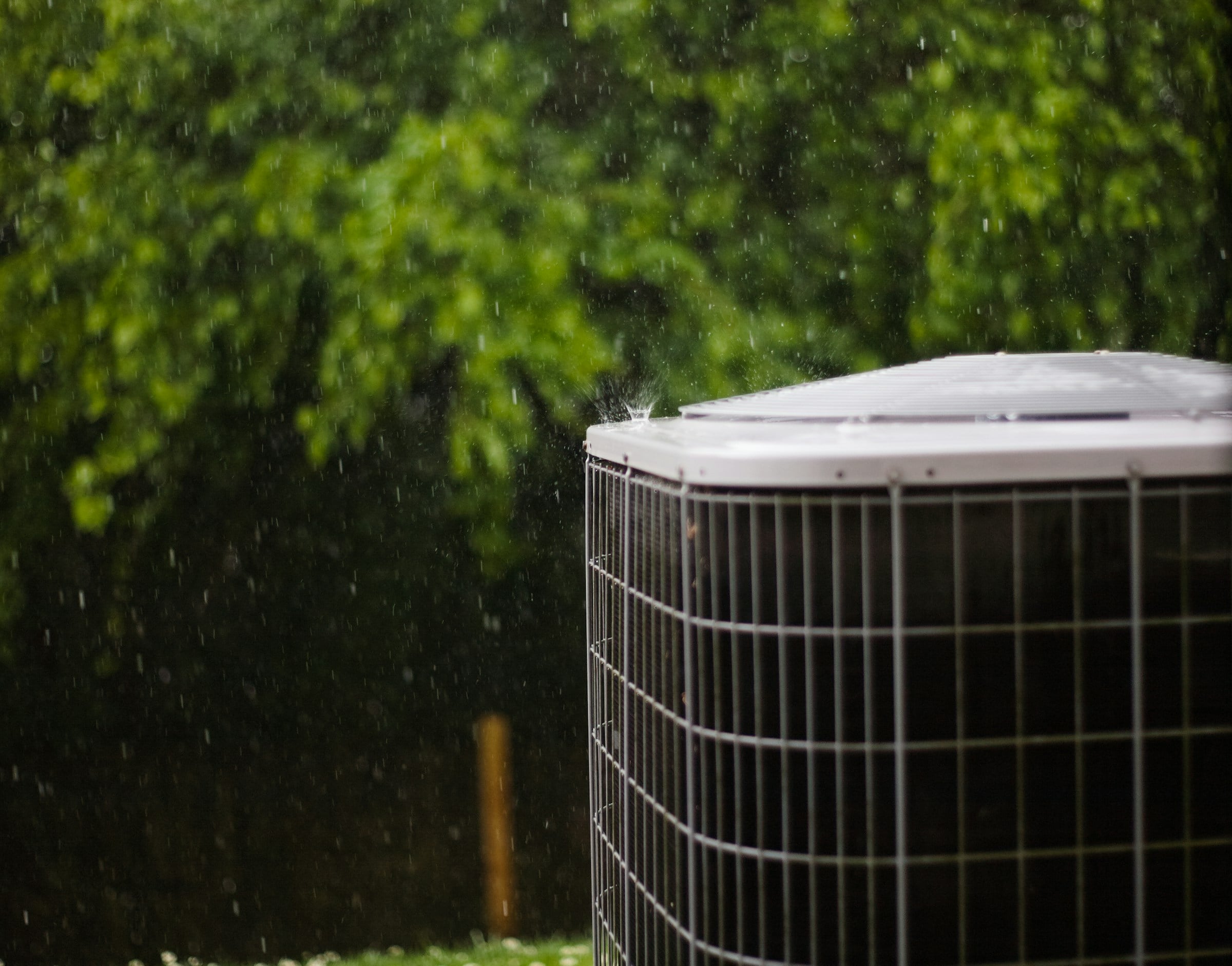
South Carolina ranks among the most lightning-prone states in the country, and Columbia’s summer afternoons show it. Add the flickering restoration that follows every outage and the small spikes a home’s own motors produce all day, and a Midlands house takes hundreds of surges a year. Nearly all are too small to notice, but all of them wear on the electronics inside the air conditioner, the refrigerator, and everything with a screen. Protection is layered and mostly inexpensive, and the useful way to think about it is by who does each part: you, an HVAC technician, and a licensed electrician.
How a surge reaches an air conditioner
The heating and cooling system is the most expensive thing in the house that a surge can reach. The control board, which takes the thermostat’s signal and decides what runs, burns outright in a large spike or degrades a little with each small one, so a board that should have lasted fifteen years may fail much sooner at eight, for example. The capacitor and contactor in the outdoor unit are worn by every spike and by the repeated restarts of a messy restoration, and a failed capacitor leaves the unit humming with the fan still. The compressor itself is strained when it restarts against pressure it has not released, which is what a flickering restoration asks of it. A surge rarely destroys a compressor on the spot; it shortens the life of the parts that protect it, and the compressor follows a season or two later.
Your part
- Put every electronic device that matters on a surge strip with a joule rating printed on the label, not a plain power strip. Televisions, computers, gaming systems, and the router belong on one, and a strip that has absorbed a large surge has usually spent itself and should be replaced.
- During a storm, unplug what you can, since no protector matches a cord out of the wall.
- After an outage, give the heating and cooling system a few minutes before judging it. Most systems have a restart delay built in so the compressor does not fight its own pressure.
- Set the thermostat and leave it during storm season, so the system is not called to a large jump the moment power returns.
- In the week after a storm, walk the house and note anything not working as it did, because the electronics that die are the sign that the control boards you cannot see may be damaged too.
An HVAC technician’s part
The heating and cooling system has protection of its own, and it lives in the maintenance visit. A tune-up tests the capacitor and contactor under load, which catches the surge wear that shortens their lives before it takes the compressor, and it checks the control board and the connections that a spike may have scorched. Coil cleaning, included in every Cloud 10 Membership visit, lowers the compressor’s operating temperature, so a compressor that is strained by a restoration is not also running hot. A tune-up in the weeks after a major storm is worth scheduling on its own, because a system that survived the flicker may have a weakened part that will not fail until the next heat wave. And when a surge has already done damage, air conditioning repair begins with the electrical readings, since that is where the answer usually is.
A licensed electrician’s part
A whole-home surge protective device mounts at the electrical panel and intercepts a surge before it reaches any circuit in the house, which protects everything that cannot be plugged into a strip: the air conditioner, the air handler, the water heater, the well pump, the sump pump, and the wiring itself. It is installed by a licensed electrician in about an hour, has an indicator that shows it is still working, and costs a small fraction of the compressor it protects. An electrician also confirms the grounding is sound, since a protector sends excess voltage to ground and can only do that on a home whose grounding has not corroded, and an older Columbia home is worth having checked on that point.
The generator connection
For homes with a standby generator, the transfer switch is where surges and the grid meet, and it deserves mention. The switch takes the house off the utility cleanly when power fails and returns it cleanly when stable power is back, which spares the equipment the flickers of a messy restoration, and the generator delivers steady voltage while the grid is out. That is one of the less obvious benefits of a standby generator, and it is also why the switch’s contacts are checked during generator service, since a switch damaged by a surge protects nothing.
Putting it together before storm season
- Ask a licensed electrician about a whole-home surge protector at the panel, and about the grounding, especially in an older home.
- Put the electronics on rated surge strips and replace the ones that have taken a hit.
- Schedule the spring cooling tune-up so the capacitor, contactor, and board have been checked before the lightning season.
- After any major outage, schedule a follow-up visit rather than waiting for the next heat wave to reveal what the restoration did.
The HVAC side of the job
2nd Wind has served Columbia since 1985. If a storm has left your cooling system humming, running without cooling, or dead at the thermostat, or if you would like the system checked after an outage, schedule online or through the website chat at any hour. The technician will review them with you so the recommendation is transparent.