
A heating system rarely fails all at once. Most of the no-heat calls we take in the Columbia area trace back to a part that had been weakening for weeks and finally quit on the first cold night, when the system was asked to do more than it had all year. This post walks through the five-minute checks that solve a surprising share of no-heat problems, the failures that need a technician, and the habits that keep it from happening again.
Check these first
Start at the thermostat. Make sure it is set to heat rather than cool or auto, and that the set point is above the room temperature. If the display is blank or dim, replace the batteries. Next, look at the breaker panel for a tripped breaker labeled furnace, air handler, or heat pump, and reset it once. If it trips again, stop there and call, because a breaker that keeps tripping is protecting you from an electrical fault inside the equipment. Then pull the air filter. A filter clogged with dust and pet hair chokes airflow, and a furnace that cannot move enough air overheats and shuts itself off on a safety switch. Replace the filter and give the system twenty minutes.
If you have a heat pump, take a walk outside. Frost on the outdoor coil on a cold morning is normal, and the defrost cycle will clear it on its own. A solid block of ice, or a unit buried in pine straw and leaves, is not normal, so clear the debris and let the unit run. Finally, if you have a gas furnace, make sure the gas valve on the supply line is open and that the other gas appliances in the house are working.
Why heat pumps blow cool air on cold nights
Many Columbia homes heat with a heat pump, which works by moving heat from the outdoor air into the house. As outdoor temperatures fall into the 30s, there is less heat in the air to move, and the system leans on electric auxiliary heat strips to make up the difference. The air at the vents on a heat pump is also cooler than furnace air even when everything is working, typically 90 to 100 degrees rather than 120 or more, so a system running normally can feel like it is not keeping up.
The failures that leave a heat pump house cold are a stuck reversing valve that keeps the system in cooling mode, a defrost control that lets the outdoor coil freeze solid, a low refrigerant charge, and burned-out auxiliary heat strips. That last one is common here because the strips only run on the coldest nights. A strip that failed last February goes unnoticed until the next hard freeze, and then the house cannot climb past the low 60s. Each of these calls for heat pump repair by a technician with gauges and a meter.
Why furnaces fail to start or shut off early
On a gas furnace, the most common cause of no heat is a dirty flame sensor, a small metal rod that confirms the burners lit. When it is coated with residue, it cannot detect the flame, and the furnace shuts the gas off within seconds as a safety measure. A failed igniter, a pressure switch that will not close because the exhaust vent or condensate line is blocked, and a limit switch tripping from restricted airflow all produce the same pattern: the furnace starts, runs briefly, and stops. Caught early, each of these is a routine furnace repair.
A cracked heat exchanger is the failure that matters most. The heat exchanger separates combustion gases from the air that circulates through the house, and when it cracks, the furnace must stay off until the exchanger or the furnace itself is replaced. If a technician tells you the heat exchanger is cracked, ask to see it. Our technicians record video of the problem so you can see what they found before you decide.
Failures inside the equipment and failures outside the house
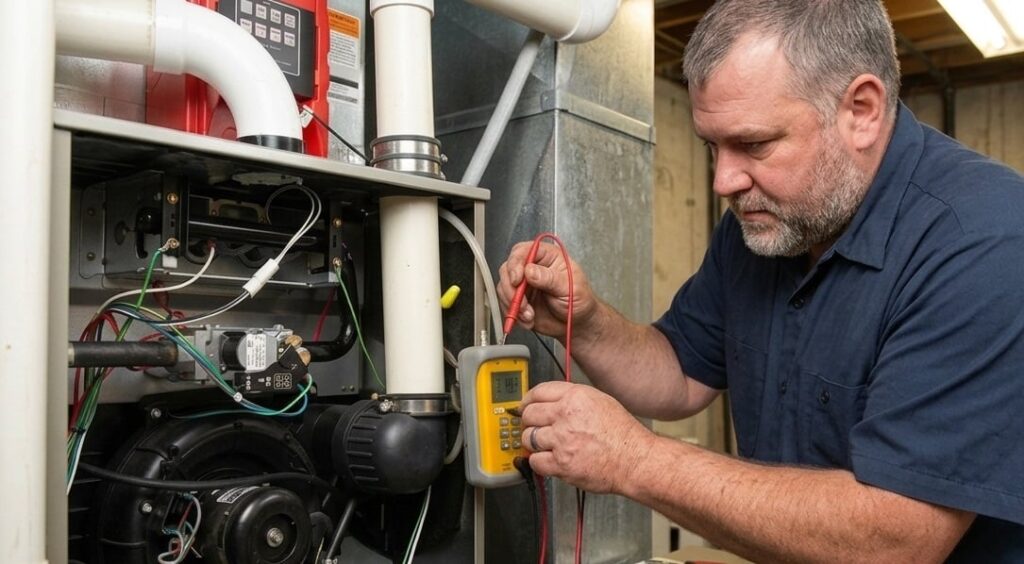
Blower motors, capacitors, control boards, and contactors fail on both furnaces and heat pumps, and any one of them stops the system. These are electrical components inside the heating equipment, and repairing them is part of heating service. The other cause of a cold house in a Columbia winter is not in the house at all. An ice storm that takes down the power takes the heat with it, since neither a furnace nor a heat pump runs without electricity. A standby generator starts automatically when the utility fails and keeps the heating system running through the outage.
How to keep it from happening again
Change the filter every one to three months during the heating season. Have the system tuned up each fall, before the first cold night, so a technician can test the heat strips, flame sensor, igniter, and safety switches under load and replace whatever is weak. A fall tune-up finds most of the failures described above while they are still inexpensive, and the Cloud 10 Membership puts that visit on the calendar each year. Pay attention to short cycling, unusual noises, and rooms that no longer heat evenly, because each one is a warning that arrives before the failure. A smart thermostat that reports system status and sends alerts adds one more early warning. And if the system is past fifteen years and needs a repair costing a third or more of a replacement, put the money toward a new system rather than another winter of uncertainty.
Same-day heating repair in Columbia
2nd Wind Heating & Air Conditioning offers same-day emergency service when the heat goes out. Same-day emergency service applies to residential properties only. Schedule online, call, or use the 24/7 chat on our website, and a trained technician will diagnose the problem, show you the failed part on video, and give you the repair options with prices before any work starts.