
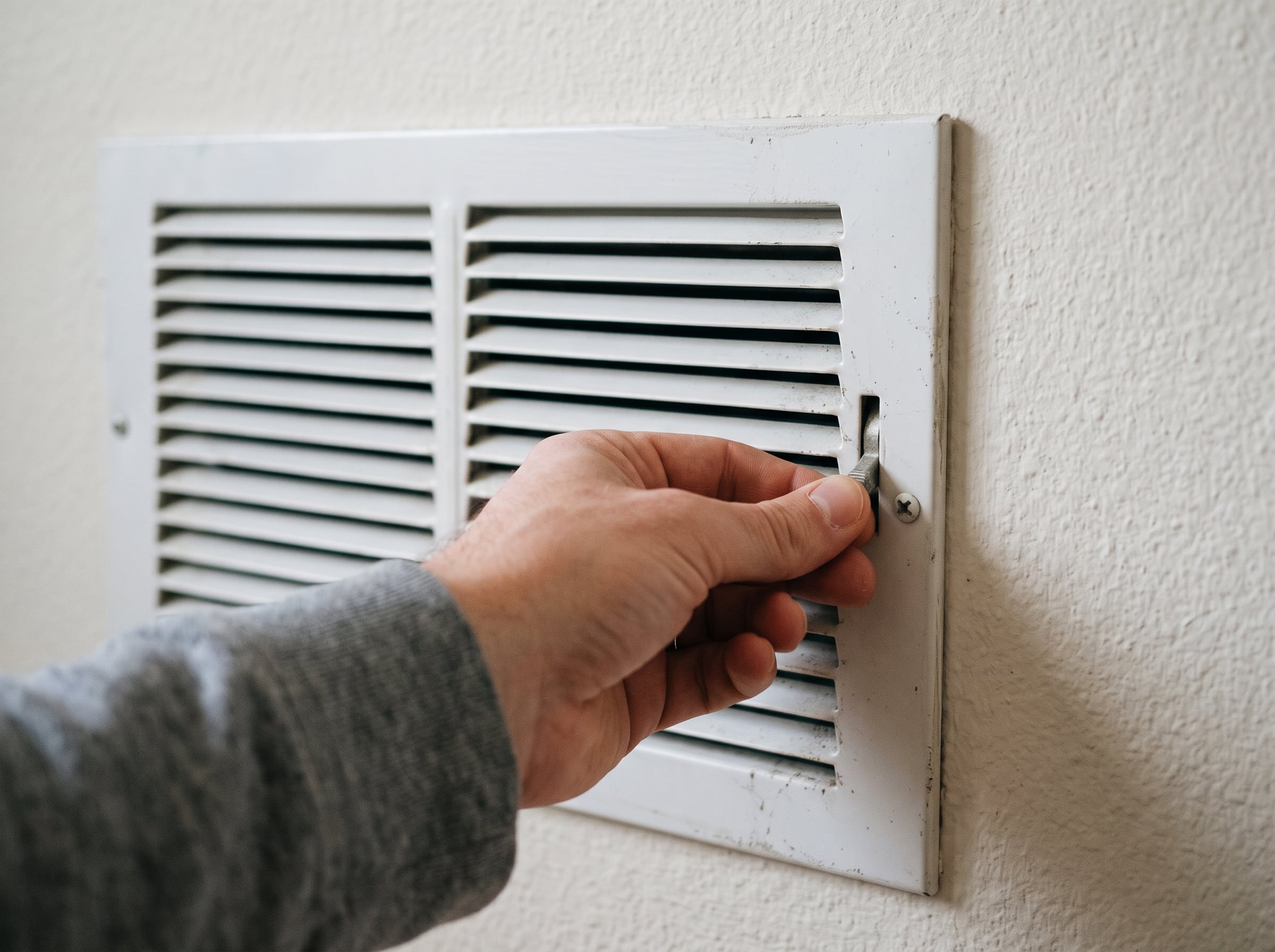
Closing the vents in rooms you are not using does not save energy in any season, and in a Columbia home it costs you twice: once in summer, when reduced airflow lets the indoor coil freeze, and once in winter, when the same restriction overheats a furnace or pushes a heat pump onto its electric backup strips. Your system produces the same amount of cooling or heating whether a register is open or closed. Closing one only changes where the air goes, and most of the redirected air ends up leaking into the attic.
The idea is reasonable on its face. An empty guest room does not need to be cooled, so shut its vent. The problem is that a forced-air system is one blower, one set of ducts, and one thermostat, and it was balanced for a certain number of open outlets.
The System Doesn’t Know a Vent Is Closed
The thermostat calls for cooling until the room it sits in reaches the setpoint. The compressor runs the same number of minutes, drawing the same electricity, regardless of which registers are open. Closing the guest room vent does not reduce that runtime. It sends the same air through fewer openings, and the thermostat still needs to reach it’s set temperature before it stops running.
What Happens in the Ducts
Close several registers and the same volume of air has fewer places to go, so pressure inside the ducts rises. ENERGY STAR estimates that a typical duct system already loses 20 to 30 percent of its air through leaks and poor connections, and higher pressure forces more air through every one of them. In a Midlands home, those ducts run through an attic or crawl space, so the air you kept out of the guest room cools the attic instead. Higher pressure also makes registers noisier and pops the tape on flex duct joints over time.
Summer: The Coil Freezes
This is the part that catches Columbia homeowners. The indoor coil needs a steady volume of warm room air passing over it. Cut that airflow with closed vents and the coil gets colder than it should, moisture on its surface freezes, and ice builds until the airflow stops altogether. From the living room, that looks like weak, warm air from the vents on a 95-degree afternoon, followed by water on the floor when the ice melts. Closed registers are one of the most common reasons we find a frozen coil in July.
Winter: The Furnace Overheats or the Strips Come On
A furnace or gas pack moves heat off its heat exchanger with the same airflow. Restrict it and the exchanger runs hotter until a safety switch shuts the furnace down, and repeated overheating shortens the life of the most expensive part in the furnace. A heat pump responds differently. Less airflow across the indoor coil means less heat delivered, the thermostat decides the heat pump cannot keep up, and it calls for the electric backup strips, which cost several times more to run. A closed vent in the spare room can quietly raise the winter power bill through that chain of events.
Comfort Gets Worse
Ductwork is balanced at installation so each room gets the air its size and exposure call for. Closing a vent throws off the whole house. Rooms near the equipment get too much air, rooms at the end of the runs get too little, and the closed-off room swings far from the rest of the house. In the rare Columbia hard freeze, a closed-off room on an exterior wall can take the pipes in that wall below freezing while the rest of the house stays warm, which is the pattern behind many of the burst pipes the Christmas 2022 cold snap caused across South Carolina.
What Works Instead
- Set the thermostat up a couple of degrees in summer and down a couple in winter for the whole house, which the Department of Energy reports saves as much as 10 percent a year when done on a schedule.
- Have a technician balance the ductwork with the dampers inside the duct runs, which adjusts how much air each room gets without the pressure spike of a closed register.
- Add a ductless mini-split to a bonus room or addition that runs hot or cold, so it conditions itself and the main system stops fighting it.
- Control humidity with a whole-home dehumidifier so a higher summer setting feels comfortable in every room.
- Seal and repair the ducts, since a leak-free system delivers the air it produces to the rooms instead of the attic.
Getting Comfort Without Closing Anything
If some rooms always run hot or cold, the cause is in the ductwork, the insulation, or the balance of the system, and all three can be measured. 2nd Wind has served Columbia and the surrounding Midlands since 1985, and our trained experts check airflow, static pressure, and the ducts themselves, with video of what they find so you can see it. An AC tune-up before summer and a heating visit before winter catch the frozen coil and the overheating furnace before they happen. Schedule online or reach our team through 24/7 website chat, and we will help you get consistent comfort with every vent open.
Frequently Asked Questions
Are magnetic vent covers any better than closing the register?
No. A magnetic cover blocks the register completely, which is the same restriction as a closed damper and often a tighter one. The pressure, leakage, and coil problems are identical. Balancing dampers inside the ducts are the tool designed for adjusting room airflow.
Can I close vents in a room I have sealed off for a renovation?
For a short renovation, closing one or two registers to keep dust out of the ducts is reasonable, and covering the return grille in that room is more important than the supply. Keep the rest of the house’s registers open, and have the ducts checked afterward, because construction dust finds its way into the system regardless.
Why does my system make a whooshing noise when I close vents?
The noise is air moving faster through the remaining open registers as duct pressure rises, and it is the sound of the restriction. Louder registers after closing vents are a direct sign that the system is being forced. Opening the vents removes the noise and the strain.
Does closing vents help a room that is too cold in summer?
Partially closing that room’s register is the one situation where adjusting a register makes sense, because the system is overdelivering to that room. Better still, have a technician adjust the balancing damper in the duct run, which solves it without affecting the rest of the house. Fully closing the register is still a bad idea.
What about rooms we never use at all, like a finished attic?
A conditioned space that is never used still needs enough airflow to keep its humidity in check, especially in the Midlands, where a closed-off room goes musty within weeks. A lower setting for that zone, or a mini-split that runs only when needed, costs less than the mold remediation a sealed-off room can eventually require.