
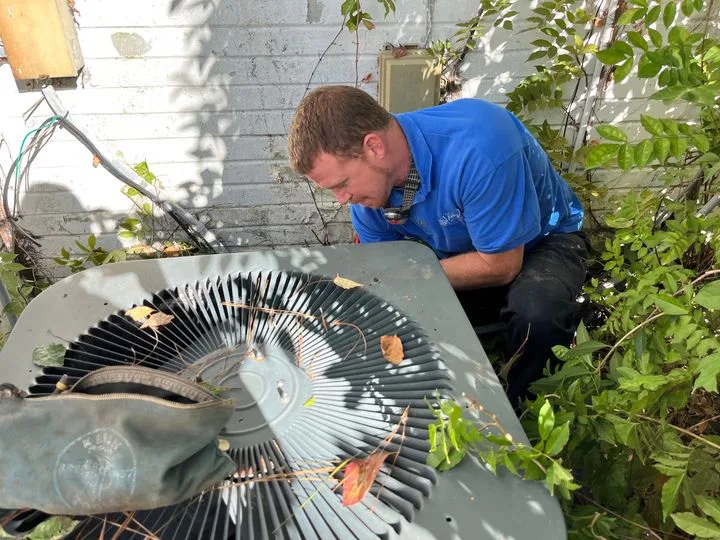
It is easy to treat a spring tune-up as optional, especially when the system cooled the house fine last summer and nothing seems different this year. So rather than list reasons, this post follows a Columbia cooling system that skipped its spring visit through the season, month by month. It shows where the small problems a tune-up would have caught turn into the calls we take in July. Then it covers what the visit does to change that story.
April: the season starts with a dirty coil
The first warm week arrives, and the system starts a shift that will run into October. The outdoor coil is coated in the pollen that fell all March, and the indoor coil carries a winter of dust and whatever grew on it during a humid fall. Neither is visible from the yard. The system cools, but it cools by running longer than it should, and the compressor runs at a higher pressure and temperature than it was designed for. Nothing might fail in April. The bill for April is a little higher than last year’s, and nobody notices.
May: the capacitor starts to wear down
The capacitor inside the outdoor unit gives the compressor and fan the push they need to start, and heat is what wears it out. A capacitor that was slightly weak in March is now starting the motors a little harder each morning, and the motors draw extra current every time, which heats their windings. The outdoor unit hums for a moment before the fan catches. It still runs, and the hum is easy to miss over the sound of the yard.
June: the humidity arrives and the drain clogs
Columbia’s humidity settles in, and the system begins pulling gallons of water out of the air every day, all of it leaving through a narrow condensate line that has been growing algae since April. The house starts to feel sticky at 74 degrees, because a system on a dirty coil short cycles and cools the air without running long enough to dry it. The drain pan under the air handler in the attic has an inch of water in it, and a musty smell appears when the system starts.
July: the first 100-degree day
The heat wave arrives, every air conditioner in the Midlands runs without pause, and the weak spots give out together. The capacitor fails and the outdoor unit hums with the fan still, or the float switch trips on the full drain pan and shuts the system down with nothing mechanically wrong. Or the compressor, which has run hot on a dirty coil for three months and started hard on a weak capacitor for two, trips its overload and does not come back. Every schedule in Columbia is full that week, and the repair happens at after-hours rates, or in a hot house days later.
September: the season’s bill arrives
If the system survived, September brings the reckoning in a different form. Six months of bills that each ran a little higher than they needed to. A compressor that has aged a summer’s worth in a season and a half. And, if a warranty claim was needed along the way, a letter explaining that the manufacturer requires documented professional maintenance to honor it, which is the letter that stings most.
What the spring visit changes
Every failure in that story is something a technician measures or cleans in an hour in March. The coils are cleaned, which brings efficiency and dehumidification back and lowers the compressor’s operating temperature for the whole season. The capacitor and contactor are tested under load and replaced if they are weakening, which is how a small part stays a small part. Refrigerant pressures are checked with gauges, since a slow leak cannot be judged by feel. The condensate line is cleared and treated and the float switch confirmed. Connections are tightened, airflow is measured, and the readings are recorded and reviewed with you so you can see what the system’s numbers look like and what, if anything, is drifting. Our maintenance page lists the full visit, and coil cleaning is included in every Cloud 10 Membership visit rather than added on.
Why spring rather than the first hot week
The same visit in June, after the season has started, still helps, but it comes after two months of extra run time and often after the first hot week has already filled the calendar. In March or April the appointment is convenient, the weather is mild, and if the readings show a replacement coming within a year or two, there is time to compare quotes calmly. Cloud 10 members receive priority scheduling when the heat wave arrives, and 15 percent off repairs with a one-year parts and labor warranty, but the kinder outcome is to have found the problem in spring.
Scheduling your tune-up
2nd Wind Heating & Air Conditioning has served Columbia since 1985, and every summer we would rather meet a system in April than in the July story above. Schedule a spring tune-up online or through the website chat at any hour. The technician will walk you through the readings and any recommendation with the reasoning behind it.