
Fall in Columbia is often a pretty mild season. Afternoons sometimes stay in the 70s and 80s deep into October, and the first morning that calls for heat usually shows up near the end of the month. That stretch of mild weather is the best time to get your heating system ready, because the day it refuses to start will be a cold one. In this post we walk through what you can check yourself, what a professional fall tune-up includes, and how to know when a heating system is past the point where a tune-up will help.
Why fall matters more here than the calendar suggests
Most Columbia-area homes heat with a heat pump, a gas furnace, or a dual fuel system that pairs the two. In October and November, all of them do something they have not done since spring: they switch back and forth, cooling on a warm afternoon and heating the next morning. That back and forth puts stress on parts that sat idle all summer, such as the ignition components on a furnace, the reversing valve and defrost controls on a heat pump, and the auxiliary heat strips that only run when it gets cold. A part that failed quietly in April tends to announce itself now, on the first night you need it.
A furnace with a dirty burner or a heat pump running low on refrigerant will still heat the house, but it has to run longer to do it, and you pay for those extra hours every month until spring. A fall tune-up corrects those losses before they show up on a bill.
What you can do before the first cold morning
A few checks take less than an hour and head off a good share of the calls we take in November. Start by replacing the air filter, and plan to check it monthly through the heating season. Then switch the thermostat from cool to heat and set it a few degrees above the room temperature. Within a minute or two you should hear the system start, and within a few minutes you should feel warm air at the vents. If the air stays cool, if you smell dust burning for more than a few minutes, or if the system keeps starting and stopping, turn it off and schedule service.
Walk through the house and make sure furniture, rugs, and curtains are not blocking supply or return vents. Outside, clear leaves, pine straw, and shrubs at least two feet back from the outdoor unit so a heat pump can pull air through the coil. If you have a gas furnace, test the carbon monoxide detector and replace the battery. Detectors carry a stated life of five to ten years on the back label, and one past its date should be replaced.

What a professional fall tune-up covers
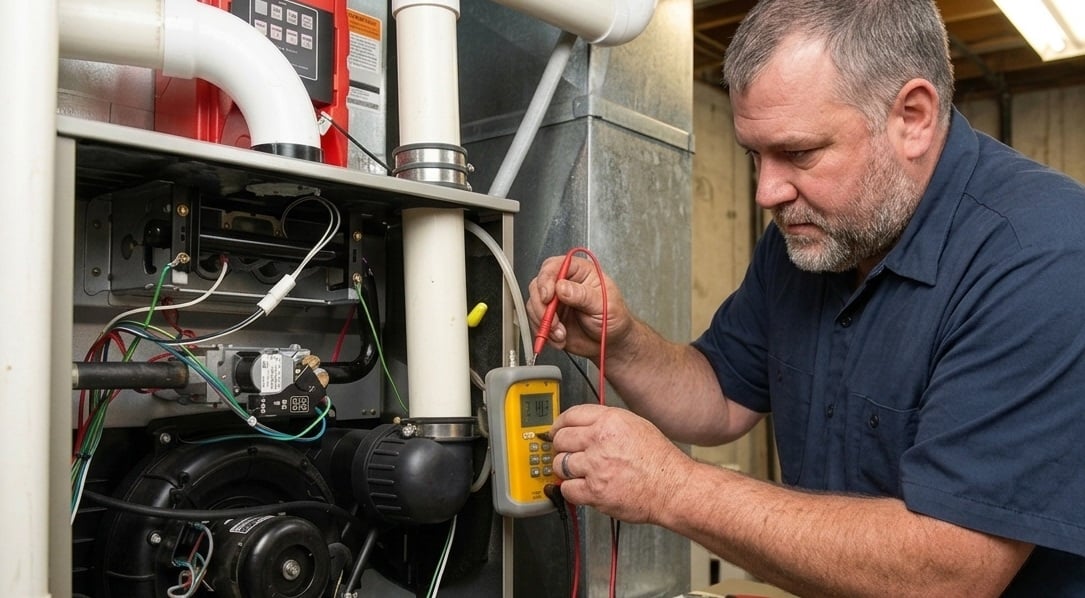
Beyond the filter and thermostat, the system needs a trained technician with test equipment, because the failures that leave people without heat in January are the ones you cannot see from the hallway. On a gas furnace, our technicians inspect and clean the burners, check the heat exchanger for cracks that could leak carbon monoxide into the house, test the ignition system and flame sensor, and measure gas pressure and temperature rise against the manufacturer’s specifications. Those checks are the core of furnace service every fall.
On a heat pump, the tune-up focuses on the parts that only matter in heating mode. We test the reversing valve that switches the system from cooling to heating, confirm the defrost cycle works so the outdoor coil does not turn into a block of ice, check the refrigerant charge, and test each auxiliary heat strip. Those strips are the backup that keeps the house warm when outdoor temperatures drop into the 30s, which in Columbia is exactly when they get called on, and a failed strip usually goes unnoticed until the first hard freeze. Our heat pump service runs each of these tests under load.
For both types of systems, we also test the blower motor and capacitor, tighten electrical connections, check the condensate drain, and calibrate the thermostat. The visit ends with a written report of what we found and what, if anything, needs attention. When we do recommend a repair, the technician records a short video of the problem so you can see it for yourself instead of taking our word for it. A fall tune-up booked now is a short, unhurried appointment. The same problems found in January are an emergency call.
When a tune-up is not enough
A fall tune-up keeps a healthy system healthy, but it cannot reverse age. Gas furnaces typically last 15 to 20 years and heat pumps 10 to 15, so a system near the end of that range that needs a major repair is usually a candidate for replacement rather than another fix. The technician will tell you the age of the system, the cost of the repair, and what a new system would save in operating cost, so the decision rests on numbers. Homeowners with an older heat pump often look at a dual fuel system at this point. It runs the heat pump on mild days, which describes most of a Columbia winter, and switches to a gas furnace on the coldest ones.
Schedule before the first cold snap
2nd Wind Heating & Air Conditioning has served greater Columbia since 1985, and every year the first week of cold weather fills our schedule with no-heat calls. A tune-up booked in September or October gets you a convenient appointment and a system that is ready when the temperature finally drops. You can schedule online or through the 24/7 chat on our website, and if you would rather not think about it each season, the Cloud 10 Membership puts both tune-ups on a schedule and moves members to the front of the line when demand peaks.